

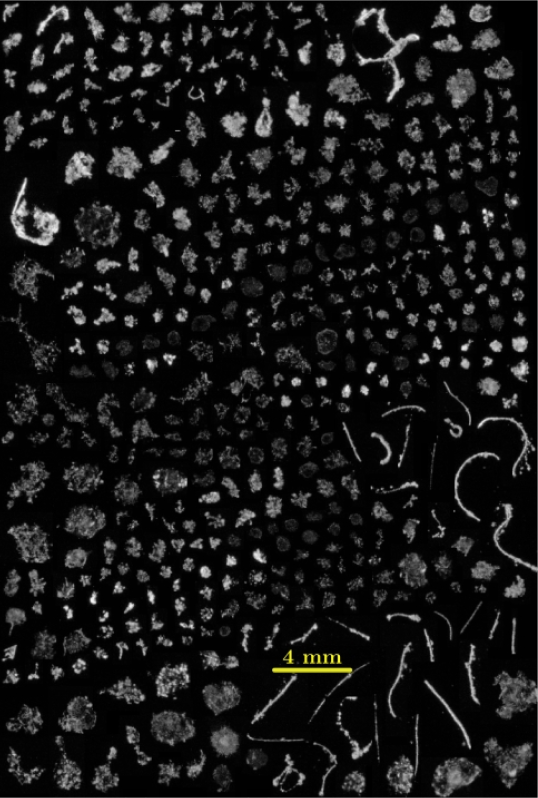
image: A variety of "snowflakes" that can be observed in the ocean. They vary in shape, density, size, and origin. Photo courtesy of Prof. Emilia Trudnowska (Instutute of Oceanology, Polish Academy of Sciences).
Credit: Prof. Emilia Trudnowska, Instutute of Oceanology, Polish Academy of Sciences.
Can “snow” fall in the ocean and influence the climate of the entire planet? It turns out that it can. Research conducted by scientists from the Faculty of Physics at University of Warsaw, published in Journal of Fluid Mechanics, helps us understand how microscopic “flakes” of dead organic matter collide and sink into the deep ocean, transporting vast amounts of carbon and affecting the pace of global warming.
In the waters of the world's oceans, particles of dead organic matter are constantly sinking. Due to their intricate shapes, which resemble snowflakes, these particles are known as marine snow. Its descent to the seafloor transports vast amounts of carbon from the ocean surface (where atmospheric carbon dioxide dissolves) to the depths. This is one of the critical phenomena controlling the carbon cycle in the atmosphere and, consequently, the process of global warming. The amount of carbon that ultimately settles on the bottom depends on sedimentation dynamics, which are still poorly understood.
As they fall, these "snowflakes" sometimes stick together, affecting their sinking rate. The fundamental question for assessing the impact of this phenomenon on sinking rates is: how often do these collisions occur? Until now, answers were limited to specific, simplified situations, and the applicability of these approximations was not clearly defined. New research published in the Journal of Fluid Mechanics (JFM) demonstrates how to reconcile existing models and allows for a more accurate determination of collision frequency, which will enable a better investigation into the role of aggregation in oceanic carbon deposition processes.
The authors verified theoretical models previously used in oceanography and marine ecology. According to their findings, snowflakes can collide in two ways: via Brownian motion – random motion of particles within the medium – and via direct „sweeping” of slower, smaller particles by those larger and faster. If only one of these mechanisms dominates, the number of collisions is easy to determine; however, in actual marine snow, both mechanisms play a role. Reconciling approaches from different fields has, until now, eluded researchers.
Full analysis is made possible through computer simulations that account for both collision mechanisms simultaneously. The frequency of collisions then depends on the size of both particles, their relative settling velocity, and the diffusion coefficient. The results confirmed that to correctly determine collision frequency, it is essential to consider both mechanisms - the diffusive wandering of small particles and the direct capture during descent. Using only one of these for modeling, as per the current paradigm, can result in an underestimation of collision frequency by up to a hundredfold.
“We investigated the validity of the only existing method for combining both phenomena, which involves summing the collision frequencies," says Jan Turczynowicz, a student at the Faculty of Physics, University of Warsaw and the lead author of the paper. "This method yields an error not exceeding 20%. In the reality of complex oceanographic measurements, this is a satisfactory result; however, it is not exact and calls into question the widely used practice of summing frequencies from successive mechanisms, which can lead to much larger errors.”
After determining the limits of applicability for Brownian collisions versus those resulting directly from sedimentation, it was possible to examine when a given mechanism begins to dominate. Interestingly, calculations showed that the boundary between the dominant collision mechanisms almost coincides with the conventional distinction between picoplankton and nanoplankton used in biological sciences.
Despite 50 years of research and its importance for understanding climate change, the phenomenon of marine snow still hides many unknowns. This is partly because the relevant processes occur across many orders of magnitude in terms of particle size and density. The theoretical considerations of the team provide a more accurate description that accounts for the different regimes of these phenomena.
Faculty of Physics at the University of Warsaw
Physics and astronomy at the University of Warsaw appeared in 1816 as part of the then Faculty of Philosophy. In 1825, the Astronomical Observatory was established. Currently, the Faculty of Physics at the University of Warsaw consists of the following institutes: Experimental Physics, Theoretical Physics, Geophysics, the Department of Mathematical Methods in Physics. The research covers almost all areas of modern physics on scales from quantum to cosmological. The Faculty's research and teaching staff consists of over 250 academic teachers. About 1350 students and over 150 doctoral students study at the Faculty of Physics UW. The University of Warsaw is among the 200 best universities in the world, educating in the field of physics according to Shanghai’s Global Ranking of Academic Subjects.
SCIENTIFIC PUBLICATION:
J. Turczynowicz, R. Waszkiewicz, J. Słomka, M. Lisicki, Bridging advection and diffusion in the encounter dynamics of sedimenting marine snow, J. Fluid Mech. (2026), vol. 1031, A5, https://doi.org/10.1017/jfm.2026.11282
CONTACT:
dr hab. Maciej Lisicki, prof. UW
Faculty of Physics, University of Warsaw
mklisicki@uw.edu.pl
https://softmatter.fuw.edu.pl
tel. +48 22 55 32 910
dr Jonasz Słomka
Faculty of Physics, University of Warsaw
jslomka@fuw.edu.pl
RELATED WEBSITES WWW:
https://www.fuw.edu.pl
Website of the Faculty of Physics, University of Warsaw
https://www.fuw.edu.pl/press-releases.html
Press service of the Faculty of Physics, University of Warsaw
GRAPHIC MATERIALS:
FUW260514b_fot01
https://www.fuw.edu.pl/tl_files/press/images/2025/FUW260514b_fot01.png
A variety of "snowflakes" that can be observed in the ocean. They vary in shape, density, size, and origin. Photo courtesy of Prof. Emilia Trudnowska (Instutute of Oceanology, Polish Academy of Sciences).

FUW260514b_fot02
https://www.fuw.edu.pl/tl_files/press/images/2026/FUW260514b_fot02.png
A visualization of the concentration of particles surrounding a sedimenting, absorbing sphere. The absorption area is marked with a dashed line. On the left, the image displays the particle density, where the darkened area represents a depleted wake left by the sphere. On the right, the trajectories of individual particles are marked in blue. The particles follow the flow paths around the sphere, and exhibit random Brownian motion. (Source: Jan Turczynowicz, Faculty of Physics, University of Warsaw).
Journal
Journal of Fluid Mechanics
Article Title
Bridging advection and diffusion in the encounter dynamics of sedimenting marine snow
Article Publication Date
23-Mar-2026